
Pigeon Nesting Season in Singapore: Why Your Aircon Ledge Is at Risk Right Now

Updated: Jul 24
QUICK ANSWER
Unlike temperate countries with distinct spring nesting seasons, pigeon nesting season in Singapore affects your aircon ledge year-round — with peak activity typically from February to April and August to October. If pigeons have been eyeing your HDB aircon ledge, nesting season is when a casual visitor becomes a permanent resident. Once a pair starts nesting on your ledge, the damage accelerates rapidly — and the only way to stop it is a physical barrier. This guide covers when nesting peaks, what to watch for on your aircon ledge, and why acting before nesting starts is always cheaper than acting after. DID YOU KNOW? A pigeon pair can produce up to 8 clutches of eggs per year in Singapore's warm climate — compared to just 2–3 in cooler countries. Each clutch takes 17–19 days to hatch, followed by another 25–30 days before the chicks fledge. That's a pigeon family occupying your aircon ledge for up to 6–8 weeks per breeding cycle — and they'll return to the same spot for every subsequent clutch.
In most countries, "nesting season" has a clear start and end. In Singapore, it doesn't — pigeons breed continuously throughout the year, with activity peaking twice annually. For HDB homeowners with exposed aircon ledges, this means there's no safe window to delay. A ledge that's unprotected in February is at risk. So is one in August. And once nesting begins, the damage to your outdoor unit compounds with every week the birds stay.
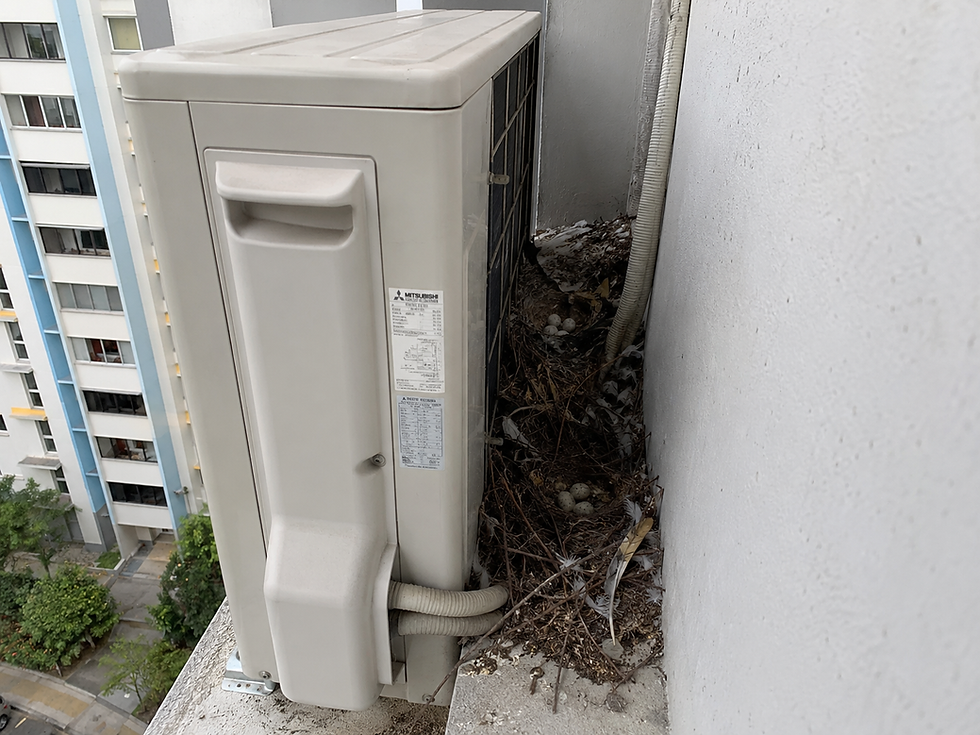
When Is Pigeon Nesting Season in Singapore and Why Is Your Aircon Ledge at Risk?
Singapore's year-round warmth means pigeons never fully stop breeding — but activity peaks at two points in the year.
Period | Nesting Activity | Risk to Your Aircon Ledge |
February — April | Peak season 1 — high activity | High — pairs actively seeking nesting sites |
May — July | Moderate — some pairs still active | Moderate |
August — October | Peak season 2 — second surge | High — second wave of nesting activity |
November — January | Lower activity | Lower but not zero |
The key takeaway: there is no completely safe window. Singapore's climate allows pigeons to breed continuously — the "off-season" is simply a period of lower risk, not no risk. If your ledge is unprotected, it's vulnerable 12 months a year.
Why Do Pigeons Choose Aircon Ledges for Nesting?
Understanding why pigeons target aircon ledges specifically helps explain why standard deterrents don't work — and why netting does.
What pigeons look for in a nesting site:
Elevated position away from ground predators
Sheltered from rain and direct wind
Flat surface with walls on at least two sides — mimics cliff-face nesting in the wild
Warm microclimate — the heat output from your outdoor unit creates an ideal temperature for eggs and chicks
Proximity to food sources — HDB estates with food courts, markets, and residents feeding birds nearby
HDB aircon ledges tick every single box. The outdoor unit itself acts as a heat source that keeps eggs at optimal incubation temperature — making your ledge more attractive than an unheated surface nearby.

What Nesting Does to Your Aircon Ledge
The damage from nesting is faster and more severe than damage from casual roosting — because a nesting pair is on your ledge every single day, for weeks at a time, producing droppings in concentrated volumes directly adjacent to your outdoor unit.
Stage of Nesting | What's Happening on Your Ledge | Damage to Outdoor Unit |
Pair scouting (pre-nesting) | Birds visiting repeatedly, testing the space | Droppings beginning to accumulate |
Nest building | Twigs, feathers, debris compacting on ledge | Drainage outlets beginning to block |
Incubation (17–19 days) | Pair present continuously, heavy dropping volume | Accelerated acidic corrosion of condenser fins |
Chick rearing (25–30 days) | Full family on ledge, maximum dropping output | Corrosion advancing, drainage partially blocked |
Fledging and return | Chicks leave, pair immediately begins next clutch | Damage compounds — pair never fully vacates |
A single completed nesting cycle — from egg laying to chick fledging — is 6–8 weeks of concentrated, daily exposure for your outdoor unit. Multiply that by up to 8 cycles per year and the corrosion, drainage blockage, and electricity impact becomes significant very quickly.
How to Tell If Pigeons Are Nesting on Your Aircon Ledge
Early identification matters — catching a nesting attempt before it becomes an established nest is significantly easier and cheaper to address than removing an active nest with eggs or chicks.
Signs a pair is scouting your ledge (pre-nesting):
Same pair of pigeons visiting multiple times daily
Birds sitting on the ledge for extended periods rather than passing through
Cooing sounds from the ledge area, especially in the morning
Small amounts of fresh droppings appearing consistently
Signs nesting has begun:
Visible nesting materials (twigs, feathers, dried leaves) on the ledge floor
Birds present on the ledge at all hours, not just during the day
Increased droppings volume — notably more than casual roosting
One bird visible on the ledge almost continuously (incubation behaviour)
Signs an active nest is present:
Bird refuses to leave ledge even when you approach
Nesting materials compacted into a defined nest shape
Eggs or chicks visible if you can see into the ledge
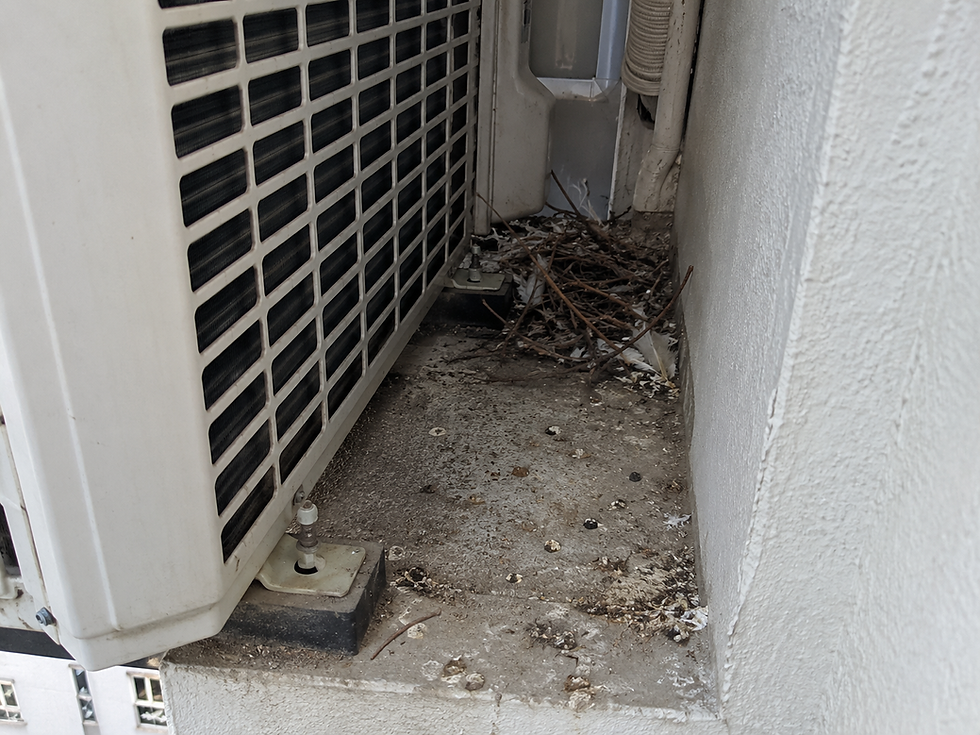
Catching a nesting attempt early — before materials compact and eggs are laid — makes the problem significantly easier and cheaper to address. These are the signs to watch for. What Should You Do If Pigeons Are Already Nesting?
This is the question most homeowners ask after they've already noticed nesting activity — and the answer depends on what stage the nesting is at.
Nesting Stage | What to Do |
Scouting — no materials yet | Book ledge wash + netting immediately. Easiest point to intervene. |
Materials present, no eggs | Remove materials + book ledge wash + netting. Still straightforward. |
Active nest with eggs | Do not disturb. Once eggs hatch and chicks fledge, remove nest, book ledge wash + netting immediately. |
Chicks present | Do not disturb. Wait for chicks to fledge, then act immediately. |
Nest abandoned | Remove materials, book ledge wash + netting before pair returns. |
Important: Once a pair has successfully fledged chicks from a ledge, they will return to the same spot for every subsequent clutch. The window between fledging and the start of the next clutch is short — typically 1–2 weeks. If you miss that window, you're waiting another 6–8 weeks for the cycle to complete again.
Why Netting Is the Only Permanent Solution During Nesting Season
Every alternative to netting — spikes, reflective tape, ultrasonic devices, decoys — relies on the pigeon choosing not to land. During nesting season, a pair that has identified your ledge as a viable nesting site will not be deterred by mild irritants. The biological drive to nest overrides all mild deterrents.
Method | Effectiveness During Nesting Season |
Plastic spikes | Low — nesting pairs build around them or use them as nest anchors |
Reflective tape / deterrents | Very low — pair habituates within days |
Ultrasonic devices | Largely ineffective — no consistent field evidence |
Decoy predators | Very low — pair identifies as non-threat quickly |
Physical netting | Permanent — pair cannot access the ledge at all |
Netting works during nesting season for the same reason it works year-round — it removes physical access to the ledge entirely. A pair cannot nest on a ledge they cannot land on. There is no habituation, no workaround, and no behavioural adaptation that overcomes a properly installed physical barrier.

What Does Nesting Season Damage Cost If Left Unaddressed?
The cost escalation from an unaddressed nesting problem follows the same pattern as any pigeon ledge issue — but accelerates faster because nesting produces higher dropping volumes over longer continuous periods.
Stage | Timeframe | Cost to Fix |
Pre-nesting — act now | Before materials appear | $150 ledge wash + $480–$780 netting |
Early nesting — materials only | Weeks 1–2 | $150 ledge wash + $480–$780 netting |
Active nesting — wait to fledge | 6–8 weeks | $150 ledge wash + $480–$780 netting + possible drainage clear |
Post-nesting damage — corrosion visible | 3–6 months of nesting | Above + possible fin repair or chemical treatment |
Long-term neglect — compressor strain | 12+ months | $600–$1,500 compressor + $500–$3,000 water damage possible |
The cost of acting before or immediately after a nesting cycle is the same as acting at any other time — $630–$930 for a ledge wash and netting. The cost of waiting through multiple cycles is significantly higher.
Frequently Asked Questions
When is pigeon nesting season in Singapore?Pigeons breed year-round in Singapore, with two peak periods — February to April and August to October. Unlike temperate countries with a single spring nesting season, Singapore's warm climate allows continuous breeding with no true off-season.
What should I do if there's an active pigeon nest on my aircon ledge?If eggs or chicks are present, do not disturb the nest. Wait for the chicks to fledge (leave the nest), then act immediately — book a ledge wash to remove all nesting materials and droppings, and install netting before the pair returns for the next clutch.
How quickly do pigeons return after a nesting cycle?Typically within 1–2 weeks of the chicks fledging. The pair will return to the same ledge for every subsequent clutch — up to 8 times per year. The window to act between cycles is short.
Can I remove a pigeon nest myself?You can remove nesting materials if no eggs or chicks are present. For an active nest with eggs or chicks, it's best to wait for the cycle to complete. After removal, a professional ledge wash is recommended to clear the residual droppings and contamination before netting is installed.
Does nesting cause more damage than regular roosting?Yes — significantly more. A nesting pair is present continuously for 6–8 weeks per cycle, producing concentrated dropping volumes directly on and around your outdoor unit. This accelerates corrosion and drainage blockage faster than casual roosting activity.
Will netting installed during nesting season still work?Yes — as long as netting is installed between nesting cycles (when birds are not actively on the ledge), it provides the same permanent protection regardless of the time of year. Installation during an active nesting cycle requires waiting for the birds to vacate before netting can be fitted.

Don't Let Nesting Season Turn Into a Repair Bill
Whether pigeons are scouting your ledge or you've already spotted nesting materials, acting now is always cheaper than waiting through another cycle. A ledge wash clears the existing contamination, and netting makes sure they can't come back.
Service | Price |
Ledge Wash | $150/unit |
HDPE Bird Netting | From $480 |
Stainless Steel Mesh | From $780 |
WhatsApp: +65 8671 6888 Rates: www.coogle.com.sg/rates Email: care@coogle.com.sg
Written by the Coogle Aircon Team. We install bird netting across HDB estates islandwide — and during nesting season we see the same pattern every time: homeowners who waited one more cycle paying significantly more than those who acted between cycles. Don't wait for the next one. Coogle Engineering Pte. Ltd. (UEN: 202568886K), rated 4.9 stars on Google.


