
Your Neighbours Already Got Aircon Ledge Netting in Singapore. Here's Why That's Now Your Problem Too.

QUICK ANSWER
When the ledges around yours get netted, the pigeons don't disappear — they relocate. Your unprotected ledge becomes the most attractive option left in the vicinity. This is one of the most common patterns we see on HDB installations: a homeowner nets their ledge, and within weeks their neighbour calls us because the bird problem suddenly got worse. If the units around you are already netted, your ledge is likely next on the pigeons' shortlist. Acting now costs $480–$780. Waiting until they've settled in costs significantly more.
DID YOU KNOW? Pigeons are highly territorial and return to established roosting sites daily. When their preferred ledge is blocked by netting, they don't leave the estate — they scout the nearest accessible alternative. Research on urban pigeon behaviour consistently shows that exclusion works on one unit displace activity to adjacent unprotected surfaces within the same building or block. In HDB estates where multiple units net simultaneously, the remaining unprotected ledges see a measurable increase in bird activity.
Most homeowners think of aircon ledge netting in Singapore as a solution to their own pigeon problem — but there's a second dynamic that rarely gets discussed: what happens to your ledge when everyone around you nets theirs. That's true — but there's a second dynamic that rarely gets discussed: what happens to your ledge when everyone around you nets theirs. If you've noticed more pigeons recently despite not having a major problem before, or if you can see netting on neighbouring ledges, this guide explains exactly what's happening — and why the window to act before the birds settle in is shorter than most people realise.
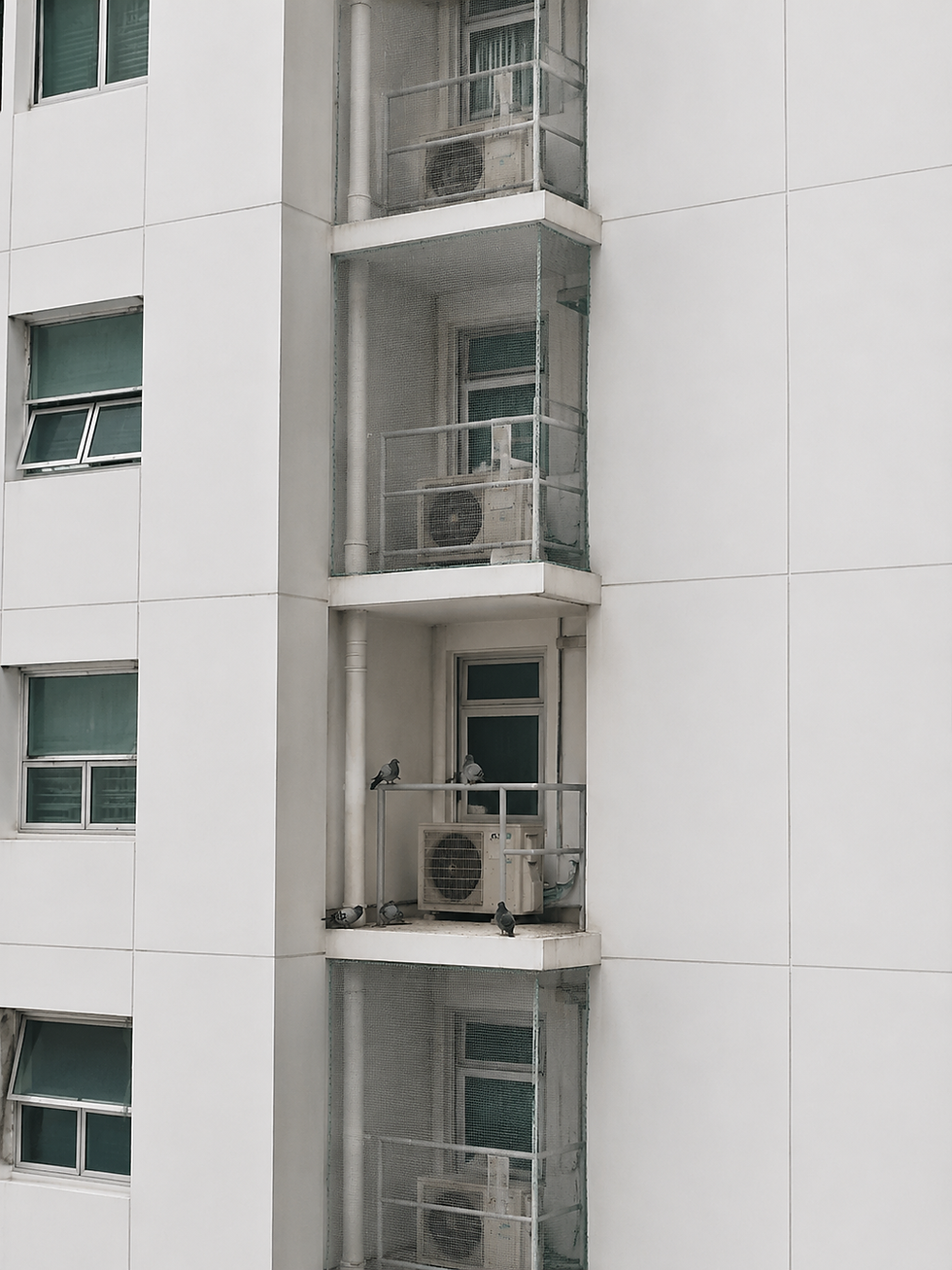
Why Aircon Ledge Netting in Singapore on Neighbouring Units Creates Risk for Yours
Pigeons are creatures of habit — they return to the same roosting and nesting sites daily, sometimes for years. When a ledge they've been using gets blocked by netting, they don't fly to another estate. They look for the nearest accessible alternative with similar characteristics.
What pigeons look for in a new ledge:
Elevated position, sheltered from rain
Flat surface with walls on multiple sides
Warm microclimate — heat from an outdoor aircon unit
Close to their previous roost — ideally on the same floor, same block, or same estate
No physical barrier preventing access
Your ledge — if unnetted — ticks every box. And because it's adjacent to their original roost, it takes very little time for a displaced pair to identify it and claim it as their new territory.
The timeline once pigeons identify a new ledge:
Stage | Timeframe | What's Happening |
Scouting | Days 1–7 | Displaced pair visits your ledge repeatedly, testing the space |
Claiming | Week 2–3 | Pair begins spending extended time on your ledge daily |
Nesting | Week 3–6 | Nesting materials appear — ledge is now their territory |
Established roost | Month 2 onwards | Pair returns daily, damage accumulates, problem compounds |
Once pigeons reach the "established roost" stage, displacing them without netting is extremely difficult. The pair will return repeatedly even after cleaning, because they've identified the ledge as their territory.

How Do You Know If Your Neighbours Have Already Netted?
You don't always need to look — there are behavioural signs on your own ledge that indicate nearby netting has displaced birds toward you.
Signs displaced pigeons are scouting your ledge:
Sudden increase in pigeon visits to your ledge despite no previous problem
Same pair of pigeons appearing repeatedly throughout the day
Morning cooing sounds from the ledge area
Fresh droppings appearing on your ledge floor or outdoor unit that weren't there before
Pigeons sitting on your ledge for extended periods rather than passing through
Visual confirmation:
Look at the ledges directly above, below, and beside yours — if you can see netting on multiple neighbouring units, displacement toward you is likely already underway
Check the ledges facing yours across the corridor or airshaft — pigeons will also relocate across short gaps
If you're seeing two or more of these signs, the scouting phase is already in progress.
What Happens If You Wait Until They've Settled In?
The cost of acting at the scouting stage versus the nesting stage is the same — $480–$780 for netting. But the additional damage and cleanup costs are very different.
Stage You Act | Netting Cost | Additional Costs | Total |
Scouting — before nesting | $480–$780 | None — ledge is clean | $480–$780 |
Early nesting — materials only | $480–$780 | $150 ledge wash | $630–$930 |
Active nesting — eggs or chicks present | $480–$780 | $150 ledge wash + wait 6–8 weeks for chicks to fledge | $630–$930 + time |
Established roost — corrosion visible | $480–$780 | $150 ledge wash + possible fin treatment | $700–$1,000+ |
Long-term neglect — compressor strain | $480–$780 | $150 ledge wash + $600–$1,500 compressor repair | $1,300–$3,000+ |
The window between "scouting" and "active nesting" is typically 3–6 weeks. After that, you're waiting for a full nesting cycle to complete before netting can be installed — another 6–8 weeks of accumulated damage.

What If Only One or Two Neighbours Have Netted So Far?
You don't need to wait for every surrounding unit to net before the displacement effect reaches you. Even one or two netted ledges nearby increases the probability that displaced birds land on yours — especially if your ledge has the characteristics pigeons prefer (higher floor, more sheltered, warmer outdoor unit).
The compounding effect:
As more units in a block or estate net their ledges, the remaining unprotected ledges carry a disproportionately higher share of the total bird activity in that area. Think of it like available parking spaces — when most are taken, the remaining ones fill up fast.
If you're currently at 3–4 netted ledges nearby with yours still unprotected, you're not at 10% risk — you may be the only accessible option left on your floor.
Should You Coordinate With Neighbours for Group Netting?
Yes — and there are two good reasons to do so:
1. Group pricing:
HDPE Netting | Stainless Steel Mesh | |
2–5 units | $440/unit | $740/unit |
6 units and above | $420/unit | $720/unit |
Coordinating with 5 other units in the same block drops the per-unit price and gets every ledge protected in one visit — eliminating the displacement cycle entirely for your floor or stack.
2. Elimination of displacement:
If every ledge in a stack or floor gets netted simultaneously, there's nowhere for displaced birds to go on that level. This is the most effective outcome — not just protecting your ledge, but eliminating the displacement dynamic for the whole group.
Approaching your neighbours — either directly or via the Town Council — about a coordinated installation is worth doing if you can see that netting has started on your block.

Frequently Asked Questions
If my neighbours net their ledges, will the pigeons definitely come to mine?Not guaranteed — but the probability increases significantly, especially if your ledge has characteristics pigeons prefer (sheltered, elevated, warm outdoor unit). The more neighbouring ledges that get netted, the fewer alternatives the displaced birds have, and the more attractive your unprotected ledge becomes.
How quickly do pigeons find a new ledge after being displaced?Scouting typically begins within days of a neighbouring ledge being netted. Active claiming of a new ledge usually happens within 2–3 weeks. Nesting can begin within 3–6 weeks of the initial displacement.
Is it worth netting even if I don't currently have a pigeon problem?Yes — especially if neighbouring ledges are already netted or you can see scouting activity beginning. The cost of netting is the same at the scouting stage as at any other stage, but the additional damage and cleanup costs are zero when you act early.
Can I ask my Town Council to coordinate netting for the whole block?Yes — Town Councils in Singapore can and do arrange block-level pest management including ledge netting, particularly in estates with significant pigeon activity. Some Town Councils have facilitated coordinated netting installations across multiple floors. It's worth raising the idea at the next residents' consultation or contacting your Town Council directly.
What if the pigeons are coming from my neighbour's ledge, not mine?Netting your own ledge removes it as an option — even if the primary roost is next door. Once your ledge is netted, displaced birds from your neighbour's ledge cannot use yours as an alternative. You control what happens on your ledge.
Can I install netting myself to save costs?Not recommended — working at height on an HDB ledge without safety equipment is a serious fall risk, most retail netting is not HDB-compliant, and incorrect tensioning means birds typically get back in within days. A failed DIY attempt followed by professional reinstallation ends up costing more than going professional from the start.
How do I get a quote quickly?WhatsApp us a photo of your ledge at +65 8671 6888 — we can quote from the photo without needing a site visit in most cases and can often schedule within the week.

Don't Be the Last Unprotected Ledge on Your Floor
The longer you wait after neighbouring ledges are netted, the more likely your ledge becomes the birds' next destination. Acting during the scouting phase — before nesting begins — keeps the cost to $480–$780 and the cleanup to zero. Waiting costs the same for netting plus progressively more in ledge wash, damage repair, and compressor strain.
Service | Price |
Ledge Wash | $150/unit |
HDPE Bird Netting | From $480 |
Stainless Steel Mesh | From $780 |
WhatsApp: +65 8671 6888 Rates: www.coogle.com.sg/rates Email: care@coogle.com.sg
Written by the Coogle Aircon Team. We install ledge netting across HDB estates islandwide — and we get called by neighbours of our own customers regularly, because the displacement effect is real. If you can see netting on the ledges around you, don't wait to find out if the birds find yours next. Coogle Engineering Pte. Ltd. (UEN: 202568886K), rated 4.9 stars on Google.


