
7 Signs Your HDB Aircon Ledge Is Dirty and Needs Cleaning in Singapore

QUICK ANSWER Your HDB aircon ledge needs cleaning if you notice any of these: visible bird droppings or debris on the outdoor unit, reduced cooling despite no change in settings, water dripping from the outdoor unit, a musty smell when the aircon runs, higher electricity bills, unusual compressor noise, or it's been more than 12 months since the last clean. Any one of these is enough reason to book a professional ledge wash — Singapore's humidity means problems compound quickly once they start.
DID YOU KNOW? A survey by the Building and Construction Authority found that aircon-related complaints are among the top 5 maintenance issues reported by Singapore HDB residents annually. The majority trace back to neglected outdoor units — and in most cases, the outdoor ledge was the starting point. Most homeowners service the indoor unit regularly but never look at what's happening outside.
Most Singapore homeowners never look at their aircon ledge. It's outside, it's hard to see from inside the flat, and as long as the aircon feels cold, there's no obvious reason to check.
But the outdoor condenser unit on your ledge is doing half the work of keeping your home cool — and when the ledge is dirty, it shows up in your electricity bill, your cooling performance, and eventually your repair costs long before you ever look out there.
Here are 7 signs your aircon ledge is dirty and needs attention in Singapore — and what each one means for your aircon and your electricity bill.

Why Knowing the Signs of a Dirty Aircon Ledge in Singapore Matters
The challenge with aircon ledge problems is that by the time you notice something obviously wrong — like a leaking unit or a compressor that won't cool — the damage has usually been building for months.
The 7 signs below appear in roughly the order they develop. Catching them early means a $150 ledge wash fixes everything. Ignoring them long enough means a $600–$1,500 compressor replacement.
Stage | Warning Sign | Cost to Fix If Caught Early | Cost If Ignored |
Early | Visible droppings or debris | $150 ledge wash | — |
Early | Musty smell from aircon | $150 ledge wash + $50 service | — |
Mid | Reduced cooling | $150 ledge wash | — |
Mid | Higher electricity bill | $150 ledge wash | Ongoing $30–$60/month extra |
Mid | Water dripping from outdoor unit | $150 ledge wash | Wall/floor damage $500–$3,000 |
Late | Unusual compressor noise | $150 ledge wash + inspection | Compressor $600–$1,500 |
Late | 12+ months since last clean | $150 ledge wash | Multiple issues compounding |
Sign 1 — Is Your Aircon Ledge Dirty? Check for Bird Droppings or Debris First
This is the most direct sign and the easiest to check. Look out your window or through the ledge access point — if you can see white or grey droppings on the top or sides of the outdoor unit, on the copper pipes, or accumulated on the ledge floor, cleaning is overdue.
Why do bird droppings matter beyond the mess?
Bird droppings have a pH of 3–4.5 — highly acidic. When they sit on your outdoor unit's aluminium condenser fins or copper refrigerant pipes, they begin corroding the metal. Over 6–18 months this leads to micro-leaks and degraded heat exchange efficiency.
What You See | What It Means |
Light spotting on ledge floor | Early stage — clean now, no damage yet |
Droppings on top of outdoor unit | Acid contact with fins beginning — clean urgently |
Droppings on copper pipes | Corrosion risk — inspect pipes during cleaning |
Thick accumulation, nesting materials | Advanced stage — full ledge wash + aircon service needed |

Sign 2 — Is Your Aircon Less Cold Than It Used to Be?
If your aircon is running normally but the room takes longer to cool, or never reaches the set temperature the way it used to, the outdoor unit is likely the cause — and a dirty ledge is the most common reason.
How does a dirty ledge reduce cooling performance?
Your outdoor condenser releases the heat extracted from your room. If debris, droppings, or nesting materials are blocking airflow around the unit — or if corroded fins are reducing heat exchange efficiency — the condenser can't do its job properly. Your indoor unit keeps running, but the system can't complete the cooling cycle efficiently.
The result: your room feels less cold, the unit runs longer, and your electricity bill climbs — all while the indoor unit appears to be working fine.
Quick test: Set your thermostat to 23°C on a cool evening. If the room still feels warm or the unit runs continuously without reaching temperature, the outdoor unit needs attention.
Sign 3 — Is Water Dripping from Your Outdoor Unit or Down Your Wall?
Some condensation on the outdoor unit is normal. But if you notice water actively dripping off the outdoor unit, pooling on the ledge, or staining the wall below, that's a drainage problem — and debris on the ledge is almost always the cause.
What causes outdoor unit water leaks?
Cause | How Ledge Cleaning Fixes It |
Nesting materials blocking drainage outlets | Removed during ledge wash |
Compacted droppings blocking drain path | Cleared during cleaning |
Algae and moss growth blocking drainage | Removed with disinfectant treatment |
Debris causing water to pool and overflow | Full ledge cleared |
Left unresolved, outdoor drainage problems eventually cause the indoor unit to leak too — resulting in wall staining, ceiling damage, and potential complaints from the unit below.

Sign 4 — Does Your Aircon Smell Musty When It Starts?
A musty or mouldy smell when your aircon starts is usually associated with the indoor unit — but the outdoor ledge can be the original source.
How does ledge contamination cause indoor smells?
When bird droppings dry on your outdoor ledge, they release airborne particles including fungal spores. Your outdoor condenser draws air from the ledge area. If that air is contaminated with mould spores or bacterial particles from droppings, they can enter the refrigerant circuit and eventually reach the indoor unit's evaporator coil — where Singapore's humidity provides perfect conditions for mould to grow.
If a general service of your indoor unit hasn't eliminated the musty smell, the outdoor ledge is the likely ongoing source.
Sign 5 — Has Your Electricity Bill Gone Up Without Explanation?
A dirty outdoor unit forces the compressor to work harder to achieve the same cooling. This is one of the clearest financial signals that your ledge needs attention — but it's also the easiest to miss because electricity bills fluctuate for many reasons.
Situation | Monthly Electricity Impact |
Clean, well-maintained outdoor unit | Baseline |
Partially blocked condenser fins | +10–15% on aircon portion |
Heavily soiled unit with droppings | +20–30% on aircon portion |
Corroded fins from prolonged exposure | +30–40%, permanent until serviced |
For a typical Singapore household running 2–3 aircon units, a 20–30% increase in aircon consumption can mean an extra $20–$50 per month on your SP Group bill.

Sign 6 — Is Your Outdoor Unit Making Unusual Noises?
Some noise from the outdoor unit is normal — a steady hum from the compressor and fan. But specific sounds indicate ledge-related problems:
Sound | What It Indicates |
Rattling or vibrating | Debris or nesting materials caught in fan blades |
Grinding | Foreign object (twig, stone) inside the unit |
Hissing | Possible refrigerant leak from corroded pipes |
Loud humming, louder than usual | Compressor working harder due to blocked airflow |
Rattling and grinding are the most directly ledge-related — debris from bird nests or accumulated debris can get drawn into the fan. Turn off the unit immediately if you hear grinding and book an inspection before running it again.
Sign 7 — Has It Been More Than 12 Months Since Your Last Ledge Clean?
If you can't remember the last time your ledge was professionally cleaned — or if it's never been done — it needs cleaning regardless of whether any other signs are present.
In Singapore's tropical climate, even a quiet, bird-free ledge accumulates:
Timeframe | What Accumulates |
3–6 months | Urban dust, diesel soot, general grime on condenser fins |
6–12 months | Algae and moss beginning on ledge surface, reduced airflow |
12+ months | Significant buildup, possible drainage issues, fin degradation |
24+ months | Corrosion visible, compressor strain measurable |
Recommended cleaning frequency:
Every 6 months — high-rise units with heavy bird activity
Every 12 months — standard HDB and condo units
Immediately — if any of Signs 1–6 are present
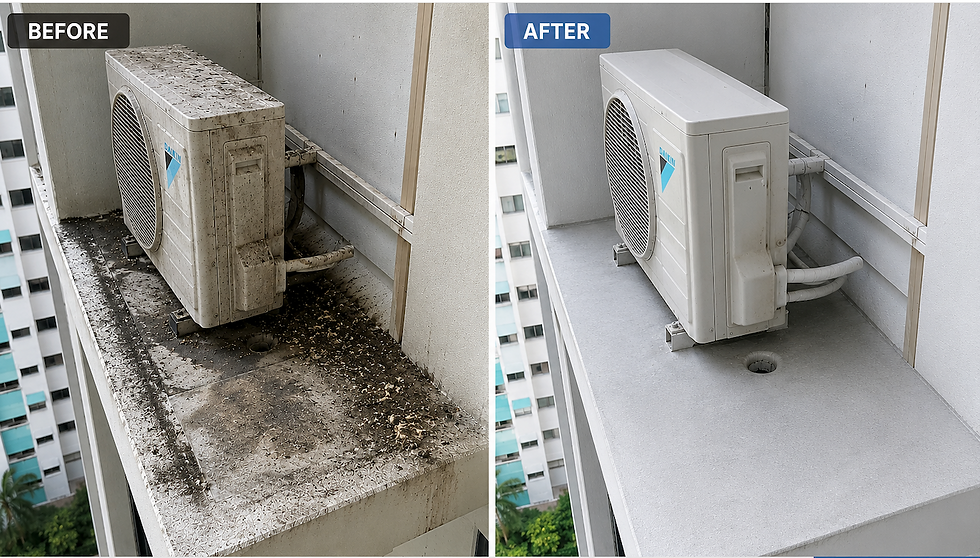
Before and after professional ledge cleaning — a clean ledge means better airflow, lower electricity bills, and no bird droppings corroding your outdoor unit. Coogle Aircon ledge wash from $150/unit. What Happens During a Professional Ledge Wash?
When you book a ledge wash with Coogle Aircon, here's exactly what happens:
Step | What We Do |
Site assessment | Inspect ledge condition, identify safety requirements |
Safety setup | Harness anchoring, PPE, debris barriers |
Debris removal | All droppings, nesting materials, leaves cleared and bagged |
Deep cleaning | Industrial cleaning solution applied to ledge surface and unit exterior |
Disinfection | Bacterial and fungal treatment — kills pathogens from droppings |
Drainage check | All drainage outlets cleared and tested |
Outdoor unit inspection | Fins, pipes, mounting brackets inspected for damage |
Final test | Unit run, cooling confirmed, any issues reported |
Ledge wash from $150/unit. If significant bird activity is the problem, we recommend combining with ledge netting installation ($480) for permanent protection.

FAQ — How to Tell If Your Aircon Ledge Needs Cleaning
How do I know if my aircon ledge needs cleaning? The 7 main signs are: visible bird droppings or debris on the outdoor unit, reduced cooling performance, water dripping from the outdoor unit, musty smell from the aircon, higher electricity bills, unusual noises from the outdoor unit, and it being more than 12 months since the last clean. Any one of these is sufficient reason to book a professional ledge wash.
Can I check my aircon ledge myself? You can look at the ledge through your window or access panel to check for visible droppings and debris. But cleaning a high-rise HDB ledge yourself is dangerous without proper safety equipment. For any ledge above the second floor, professional cleaning is strongly recommended.
How often should I clean my HDB aircon ledge? Every 12 months for most HDB and condo units. Every 6 months if you have heavy bird activity. Immediately if any of the 7 warning signs above are present.
What's the difference between a ledge wash and a general aircon service? A general aircon service focuses on the indoor unit — filters, evaporator coil, blower fan, drainage pipe. A ledge wash focuses on the outdoor unit and ledge — removing debris, droppings, and contamination from the condenser and ledge surface. Both are separate services and both are needed for complete maintenance.
How much does aircon ledge cleaning cost in Singapore? At Coogle Aircon, professional ledge wash is $150/unit. This includes safety equipment, debris removal, deep cleaning, disinfection, and drainage check. WhatsApp +65 8671 6888 for a booking.
Should I get ledge netting after cleaning? Yes — if birds are the cause of your ledge problems, cleaning without netting means the problem returns within weeks. A professional ledge wash followed by netting installation ($480) is the complete solution. Read more about ledge netting here.
BOOK AIRCON LEDGE CLEANING IN SINGAPORE If you've spotted any of these 7 warning signs — or if it's simply been over a year since your last ledge clean — don't wait for the compressor to start struggling.
WhatsApp: +65 8671 6888 Rates: www.coogle.com.sg/rates Email: care@coogle.com.sg
Written by the Coogle Aircon Team. The ledge is the most overlooked part of aircon maintenance in Singapore — and the most expensive to ignore. Coogle Engineering Pte. Ltd. (UEN: 202568886K), rated 4.9 stars on Google. Ledge wash from $150/unit, islandwide, transparent pricing.


